Credit Card Fraud Detection

Financial Analytics · Fraud Risk

Machine learning risk analytics with production-ready precision

Business Problem

Fraud represents a minute fraction of total transaction volume, yet causes disproportionate financial and reputational damage. Traditional rule-based systems and accuracy-focused models struggle under extreme class imbalance, either missing sophisticated fraud patterns or generating excessive false alerts. As fraud tactics evolve to mimic legitimate behavior, detection systems must move beyond static thresholds toward adaptive, data-driven risk intelligence. The challenge is to balance high fraud detection capability with operational efficiency and customer experience.

Methodology

We implemented a structured fraud detection pipeline designed for extreme class imbalance and real-world deployment constraints. The approach combined controlled data preprocessing, imbalance-aware training, and ensemble modeling to identify subtle behavioral fraud signals. Models were benchmarked on an untouched imbalanced test set to ensure that performance metrics reflected operational conditions rather than laboratory accuracy.
Models Evaluated

  • Naive Baseline
  • Logistic Regression
  • Random Forest

Evaluation Framework

  • SMOTE oversampling applied to training data only
  • Evaluation on original imbalanced test set
  • ROC-AUC comparison
  • Precision–Recall trade-off analysis
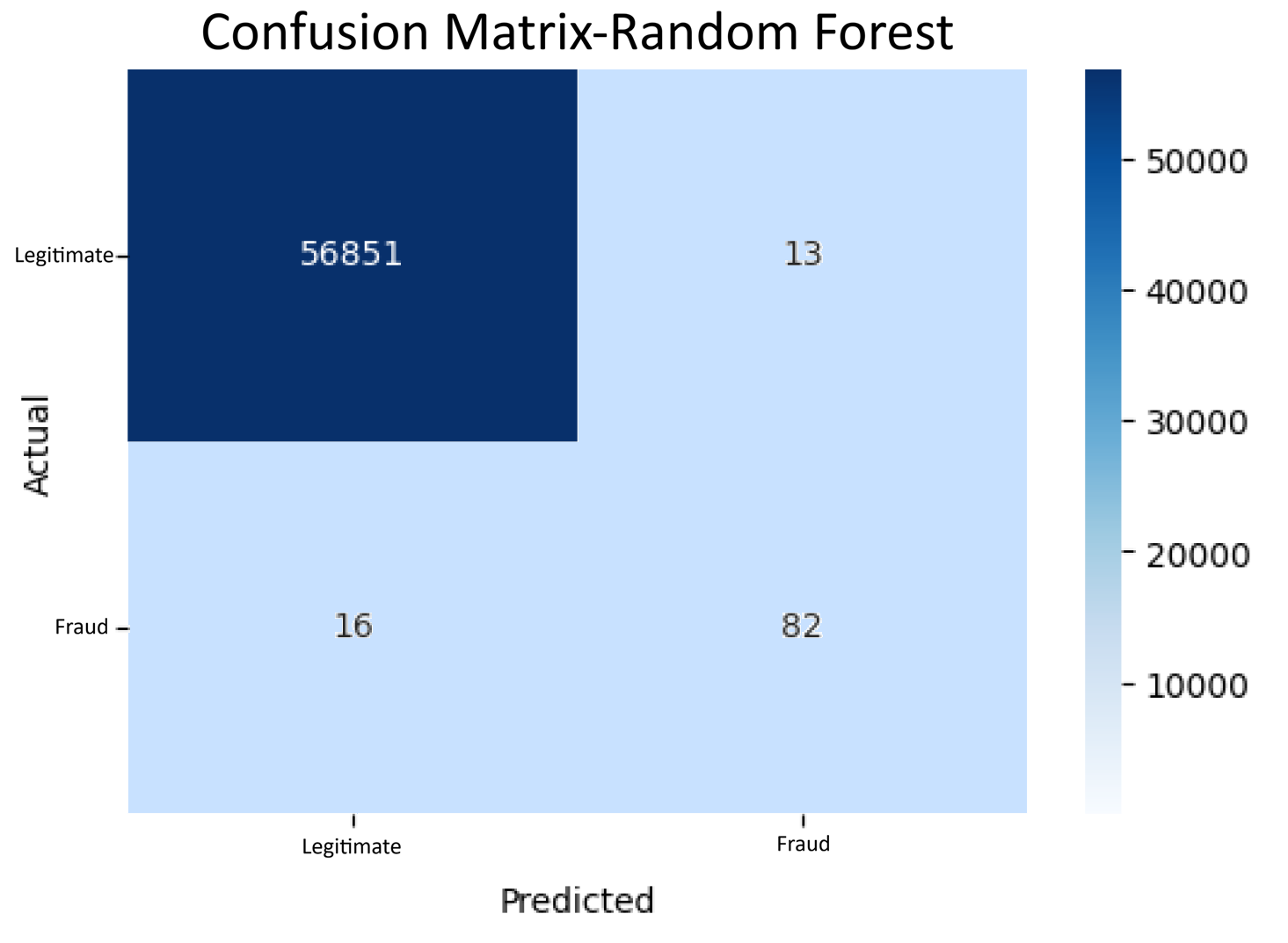
  • Confusion matrix validation

Results

Performance Summary

Fraud Recall

84%

Majority of fraudulent transactions successfully detected
Fraud Precision

86%

Most flagged transactions represent genuine fraud cases
False Positives

13

Only 13 legitimate transactions incorrectly flagged out of 56,851
ROC-AUC

0.975

Strong ranking ability across fraud probability thresholds

Business Implications

The findings highlight a critical governance gap in predictive model deployment. High backtest accuracy does not guarantee real-world stability. Without forward validation under structural change, businesses expose themselves to hidden model risk. Institutionalizing regime-aware validation is not optional — it is a risk management requirement.
Let’s discuss your problem
Whether you’re addressing a foundational data need or a complex decision challenge, we’re ready to work with you.
Start a conversation