Forecasting Under Regime Shift

Financial Analytics · Model Risk

Robust forecasting validation under structural market shifts.

Business Problem

Many forecasting models demonstrate near-perfect performance in backtesting environments but fail under structural regime shifts. Businesses relying solely on validation metrics risk deploying unstable models that degrade rapidly under evolving market conditions.

Methodology

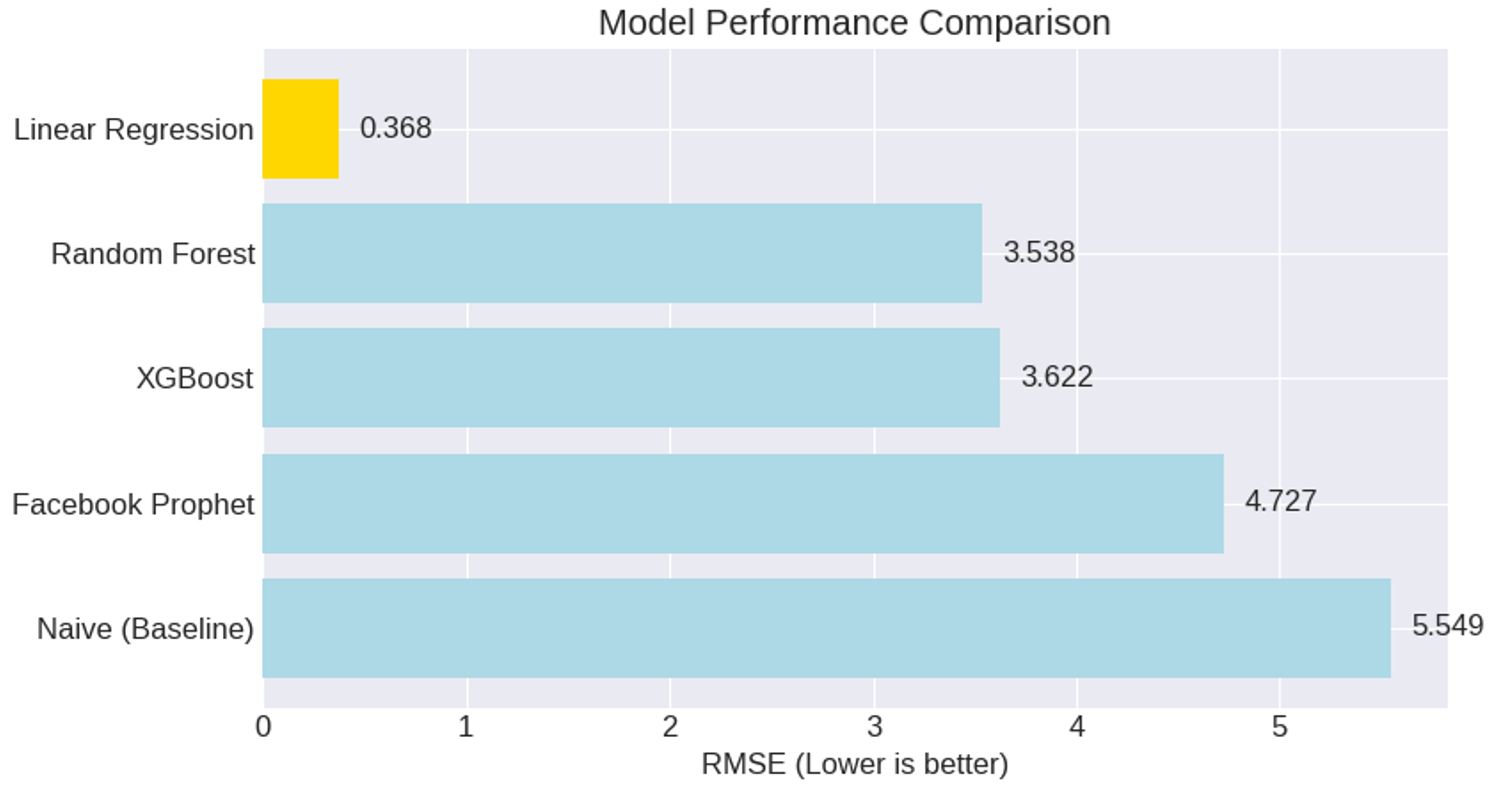
We conducted a structured benchmarking study comparing classical statistical and machine learning forecasting approaches. Models were evaluated using both validation (backtesting) and forward testing frameworks to assess stability under regime shift conditions. Performance was measured using RMSE and R² to highlight discrepancies between historical accuracy and real-world robustness.

Models Evaluated

  • Naive Baseline
  • Linear Regression
  • Random Forest
  • XGBoost
  • Facebook Prophet

Evaluation Framework

  • Backtest validation (historical split)
  • Forward testing under structural shift
  • RMSE comparison
  • R² stability analysis

Results

Performance Summary

Validation R²

0.99

Backtest performance appears near-perfect
Forward R²

< 0

Structural shift invalidates historical fit
Best RMSE

0.368

Linear Regression (lowest error)
Worst RMSE (Baseline)

5.549

Naive benchmark gap highlights sensitivity

Business Implications

The findings highlight a critical governance gap in predictive model deployment. High backtest accuracy does not guarantee real-world stability. Without forward validation under structural change, businesses expose themselves to hidden model risk. Institutionalizing regime-aware validation is not optional — it is a risk management requirement.
Let’s discuss your problem
Whether you’re addressing a foundational data need or a complex decision challenge, we’re ready to work with you.
Start a conversation